
Follow our local Boston guides on a storytelling walk along the Freedom Trail — from Boston Common to Faneuil Hall.
Hear the stories of revolution, rebellion, and everyday life in 18th-century Boston as you explore the streets where the American Revolution took shape.
This 2-hour Boston Freedom Trail walking tour brings Boston's revolutionary history to life through historic landmarks, fascinating stories, and the people who shaped the nation. And with our Pay What You Wish model, you can experience the tour at a price that works for you.

Boston's historic center may be compact, but it holds centuries of history. The streets around the Freedom Trail were the setting for some of the events that changed the course of American history.
Your guide will connect the landmarks along the trail to the people and events behind them — from Samuel Adams, Paul Revere, John Hancock, and Benjamin Franklin to the Boston Massacre and the Boston Tea Party.
Rather than simply following the red brick line, you'll learn the stories behind the places you see and how Boston's colonial past led to revolution and, ultimately, American independence.
What You'll See on Our Boston Freedom Trail Walking Tour
Boston Common
Founded in 1634, Boston Common is America's oldest public park. During the colonial period, the Common was used for grazing, public gatherings, and military activity. British troops also camped here before the American Revolution.
Today, it remains one of the most important landmarks in Boston's historic center.
Massachusetts State House
The Massachusetts State House has stood on Beacon Hill since 1798. Its famous golden dome is one of Boston's most recognizable landmarks.
Your guide will explain the building's role in Massachusetts government and how the state's political history connects to the larger story of the American Revolution.
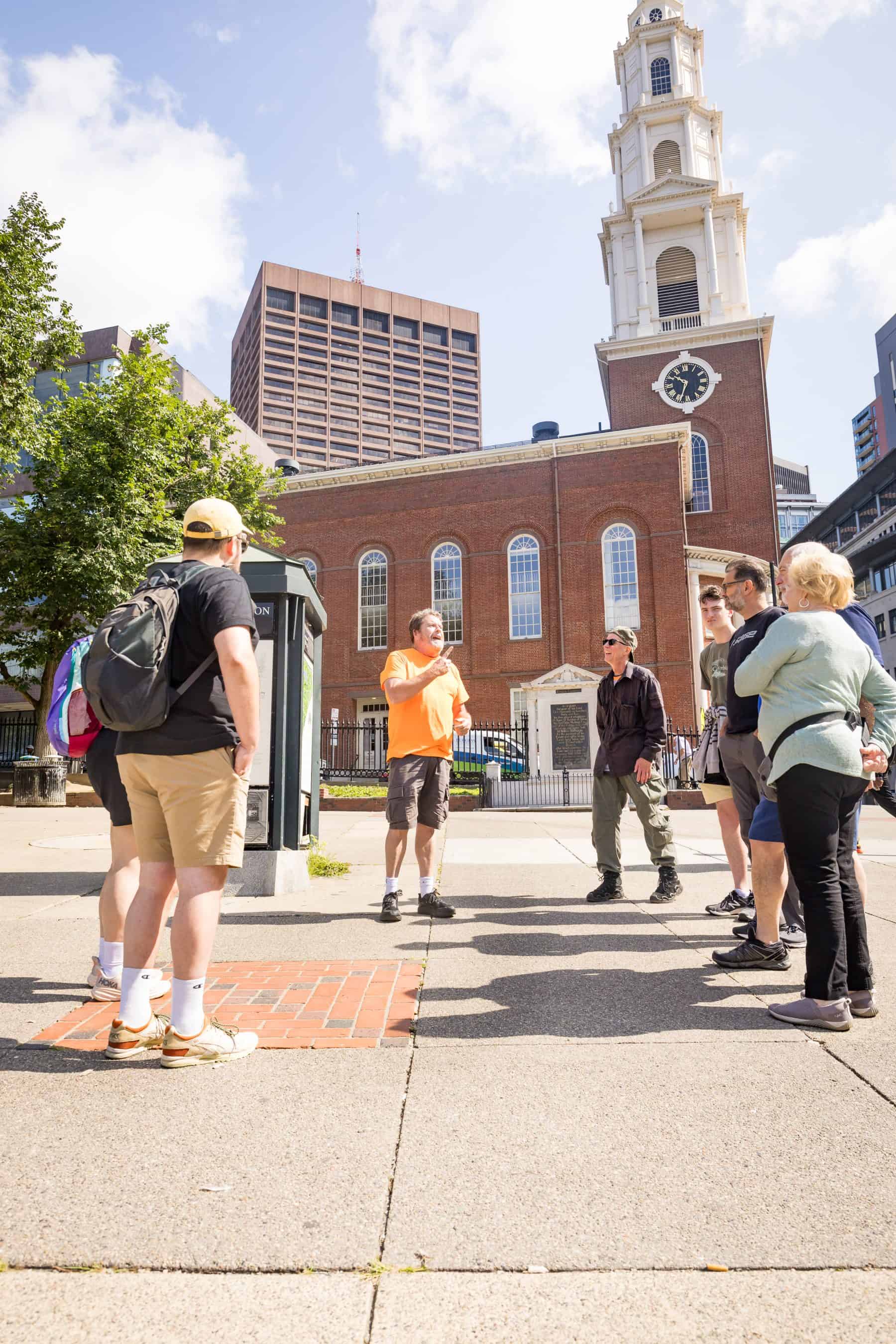
Park Street Church
Built in 1809, Park Street Church has played a role in some of Boston's important social and political movements.
We'll explore the church and the surrounding area as part of the broader story of Boston's changing society, politics, and ideas.
Granary Burying Ground
One of Boston's most historic burial grounds, Granary Burying Ground is the final resting place of several important figures from the Revolutionary era.
Look for the graves of Paul Revere, Samuel Adams, John Hancock, and other prominent Bostonians, as well as the grave of Crispus Attucks, who was killed in the Boston Massacre.
Your guide will put these people and their stories into the context of the events that led to the American Revolution.
King's Chapel
King's Chapel dates to the colonial period and reflects the religious and political divisions of early Boston.
The church and its surroundings offer a glimpse into a city where loyalists and revolutionaries lived side by side as tensions with Britain grew.
Old South Meeting House
Old South Meeting House was one of colonial Boston's most important gathering places.
In December 1773, thousands of colonists gathered here to debate what should be done with the tea ships sitting in Boston Harbor. The meeting helped set the stage for the event now known as the Boston Tea Party.
Boston Latin School Site
The Boston Latin School was founded in 1635 and is traditionally recognized as the oldest public school in America.
The site provides another perspective on colonial Boston and the importance of education in the city's early history.
Old Corner Bookstore
The Old Corner Bookstore is one of Boston's oldest commercial buildings and became an important center of Boston's literary world.
The building was associated with the Ticknor and Fields publishing house and writers including Nathaniel Hawthorne, Charles Dickens, and Harriet Beecher Stowe.

Old State House
Built in 1713, the Old State House was the center of colonial government in Massachusetts.
On July 18, 1776, the Declaration of Independence was read publicly from its balcony to the people of Boston.
The building also stands directly beside the site of the Boston Massacre, making this one of the most significant stops on the Freedom Trail.
Boston Massacre Site
On March 5, 1770, British soldiers fired into a crowd of colonists, killing five people, including Crispus Attucks.
The event became powerful revolutionary propaganda and helped increase opposition to British rule.
Your guide will explain what happened, why tensions had reached this point, and how the Boston Massacre became part of the growing movement for independence.
Faneuil Hall
Known as the "Cradle of Liberty," Faneuil Hall has been a marketplace and meeting place since 1742.
Boston's merchants, politicians, and residents gathered here to debate the issues of the day, including growing opposition to British policies.
Faneuil Hall is where our Freedom Trail walking tour ends.
Why Take a Guided Freedom Trail Tour?
The Freedom Trail is easy to follow — but knowing where to walk is only part of the experience.
A local guide can connect the landmarks to the people, conflicts, and everyday stories that made them important. Instead of simply checking historic sites off a list, you'll learn how the events of colonial Boston unfolded and how they contributed to the American Revolution.
Our guides bring those stories together as you walk approximately one mile through Boston's historic center.

Tour Information
Duration: Approximately 2 hours
Distance: Approximately 1 mile (1.6 km)
Meeting Point: Outside Park Street T Station, on the eastern edge of Boston Common (map)
End Point: Faneuil Hall
Tour Type: Guided walking tour
Cost: Pay What You Wish or prepay
Important Note About the Freedom Trail
This is an outdoor walking tour. We view the historic buildings and landmarks from the outside and do not enter museums, churches, or other attractions as part of the tour.
The tour takes place rain or shine. In the event of severe weather, we'll contact guests with available options.
Cancellation Policy
You can receive a full refund when you cancel at least 24 hours before your scheduled tour. Cancellations made less than 24 hours before the tour are not refundable.
If you booked through a third-party platform, cancellations must be made through that platform.
Tours run rain or shine. If severe weather affects the tour, we'll contact you by email or text with available options. Flexible rescheduling is also available, subject to availability.