
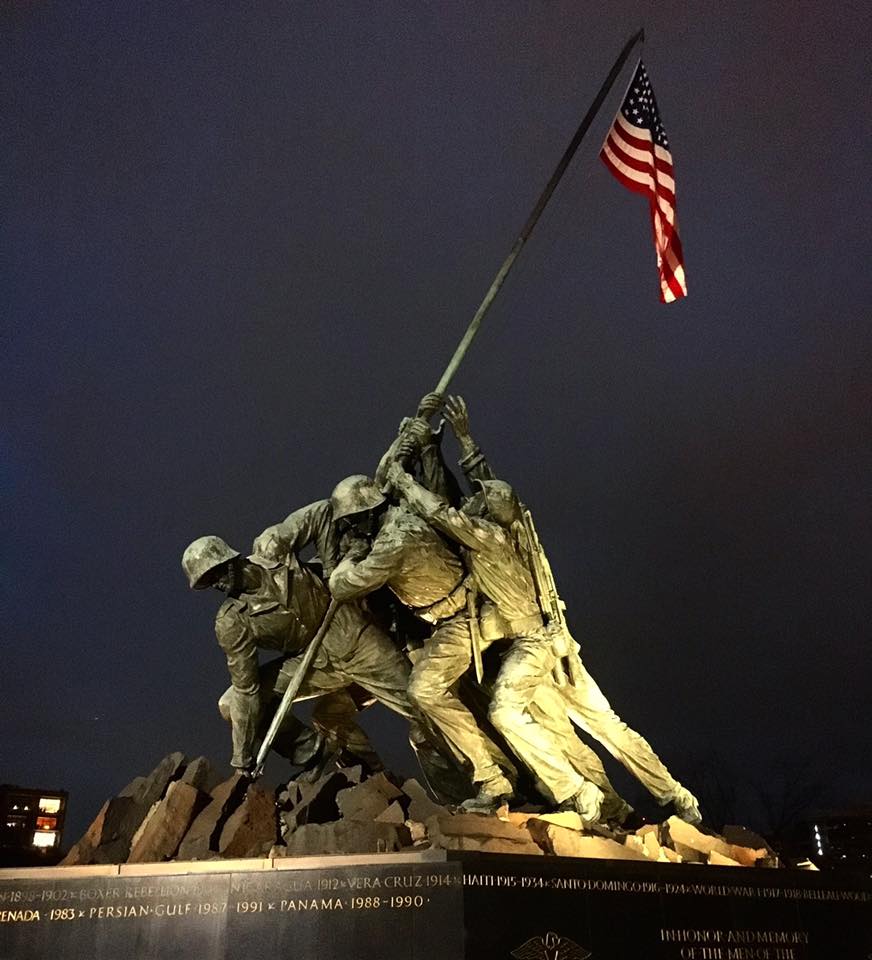
This post is a guide to the United States Marine Corps War Memorial (also known as the Iwo Jima Memorial) in Arlington, VA, just outside of Washington, DC.
Overview
The memorial is dedicated to all US Marine Corps veterans who have served and to those who have given their lives since the Marine Corps began in 1775.
This memorial is often called the Iwo Jima Memorial because it depicts the famous WWII image of the flag raisers on Iwo Jima Island in the Pacific Ocean.
We include a free audio tour of the Iwo Jima USMC Memorial for guests who take our Arlington National Cemetery tour, which ends near the memorial.

It is located in Arlington, VA, just across the Potomac River from the National Mall and just outside the walls of Arlington National Cemetery.
Although it's not on the National Mall like most other memorials, it's worth visiting. The six figures holding up the flag are an impressive sight and can be viewed both during the day and at night.
Visiting the memorial is free, and no tickets are required.
PLAN YOUR VISIT
Due to the memorial's relatively remote location, planning your visit to be as efficient with your time as possible is essential.
We think the best way to visit the Iwo Jima Memorial is with our Arlington Cemetery tour, but it's also an included stop on many bus tours.

Operating Hours
The Iwo Jima Memorial is open from 6:00 am to midnight every day. Though there are no gates, so you can, in theory, visit the memorial at any time.
The memorial recently built restroom facilities, water fountains, and trash cans nearby.
It is also near Arlington National Cemetery, where the visitor center has restrooms.
The Iwo Jima Memorial is a popular memorial to visit at night.
It is lit to make the figures look even more imposing and is a sight seen as people drive by. Though rangers are not on site all night, it is relatively safe.
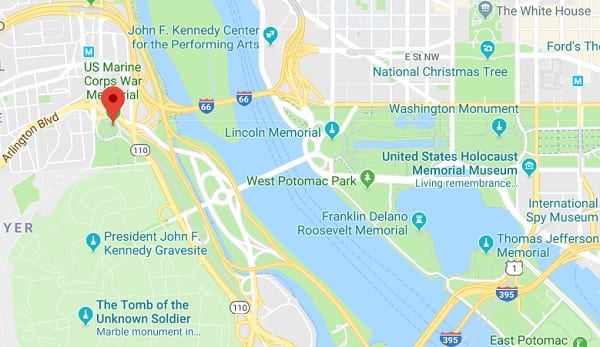
Where Is the Iwo Jima Memorial Located?
The Iwo Jima Memorial is located in Arlington, Virginia, just north of Arlington National Cemetery and across the Potomac River from Washington, DC.
Regardless of how you decide to get here, we recommend using this Google map for directions.
Below are our tips for visiting on your own, whether by car, public transportation, biking, or walking.
However, most visitors come via an organized bus tour. Several tours come during the day, but most bus tours visit at night.
Events
During the summer, the US Marine Corps holds Sunset Parades on Tuesday evenings at the memorial. You may also see them practicing during the day before the parade.
On nights the event runs, you will find night bus tours skip this memorial, and we recommend you don't plan on driving there yourself.
Parking
Limited parking is available on the memorial grounds. Additional street parking is available along North Meade Street and in the neighborhood to its east.
If you are coming for a quick photo, you should be able to accomplish this by parking in the lot at the far end of the circle. There are usually spots available outside of events happening at the memorial.
You can also park at Arlington National Cemetery and walk to the memorial in 15 minutes (see more below).
Public Transit
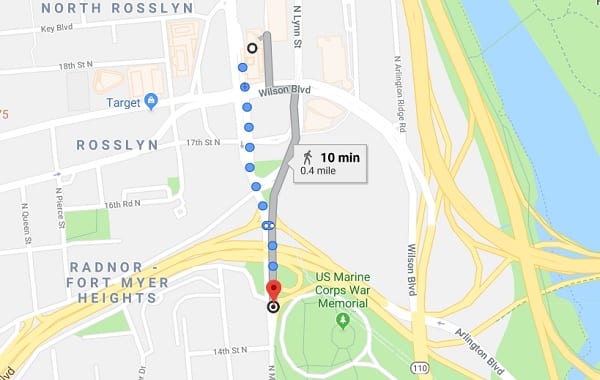
The Rosslyn Metro Station (Blue/Orange/Silver) is the closest station. The memorial is a 10-minute walk away.
Head south on Fort Myers Dr. toward Wilson Blvd. Eventually, take a left on Meade Street. You will see the Iwo Jima Memorial on your left.
You can also arrive at the Arlington Cemetery Metro Station (Blue Line). After exiting the station, walk towards the cemetery entrance.
Within 100 yards, you will note a bike path that veers off to the right. Follow that path as it takes you alongside the highway and ends on the outskirts of the cemetery (10 min. walk).
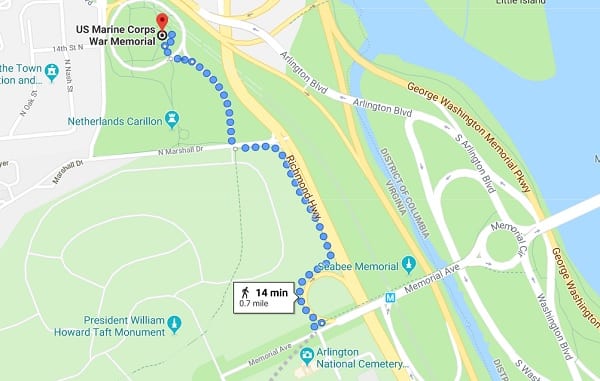
Walk straight over the small grassy hill before you, passing the Netherlands Carillon Bell Tower on your left.
The Marines Corps Memorial will be straight ahead (5 min walk).
It can also be accessed from inside Arlington National Cemetery, so visitors can add Iwo Jima as a follow-up to their visit there.
You can exit the cemetery via the Ord-Weitzel Gate, which is on the north side of the cemetery, by Section 27.
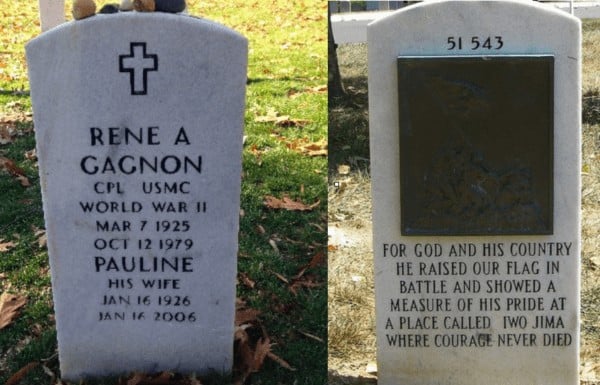
If you go this route, you will pass the gravesite of Rene Gagnon, who was initially identified as one of the flag raisers depicted in the famous image. The back of his headstone depicts the flag-raising.
Bike
You can also bike to the Iwo Jima Memorial. There is even a Capital Bikeshare station right next to the memorial.
We have a post with tips on renting a bike in DC.
Nearby Attractions
Due to its location, you might find it beneficial to also plan to visit other memorials that are adjacent or nearby, such as:
Be sure to read our guide to all memorials and monuments in Washington, DC.
Self-Guided Tour of the Iwo Jima US Marine Corps Memorial
Welcome to the Marine Corps Memorial, often mistakenly called the Iwo Jima Memorial. But, as you can read on its east side, this magnificent sculpture is dedicated “In Honor and Memory of the men of the United States Marine Corps who have given their lives to their country since November 1775.”
There is no correct way to visit the memorial, but we start by explaining the significance of Iwo Jima. Feel free to read it from any location on the memorial plaza.
You may have seen this sculpture before, on television or in movies, or you may have seen the famous photograph by Joe Rosenthal, from which the image for the sculpture was taken. The picture quickly became an iconic expression of World War II, which is probably why many people thought this was a national World War II memorial before the real one was completed on the National Mall in 2004.
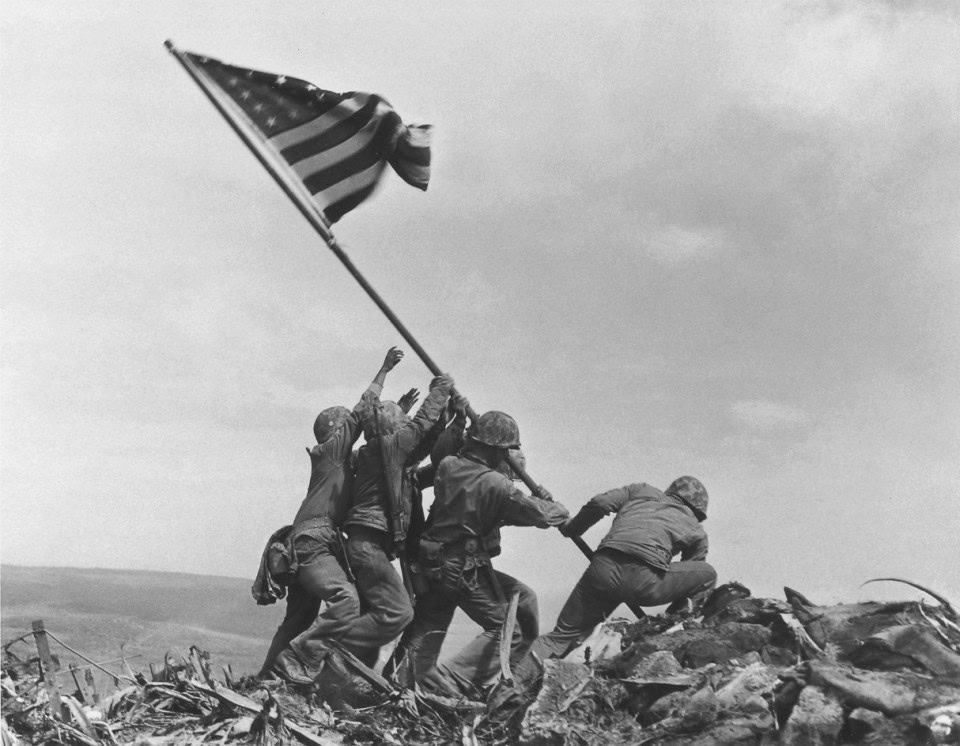
There is a persistent rumor that this fantastic photograph was “staged” somehow, but that could not be further from the truth. To understand the incredible circumstances that led to this picture, we need to understand a bit about the Battle of Iwo Jima.
The Battle of Iwo Jima in February and March 1945 quickly became a defining moment for the United States Marine Corps. It came in the midst of the United States’s “Island Hopping Campaign,” which had led the US to attack and liberate all the many different Pacific island nations and territories that the Japanese Empire had conquered at the beginning of the war.
The volcanic island of Iwo Jima was an insignificant little chunk of land, only about 11 square miles, and dominated by a single volcanic mountain called Mt. Surabachi, which was about 500 feet tall (roughly the size of the Washington Monument). The rest of the island was almost flat and shaped like a pork chop.
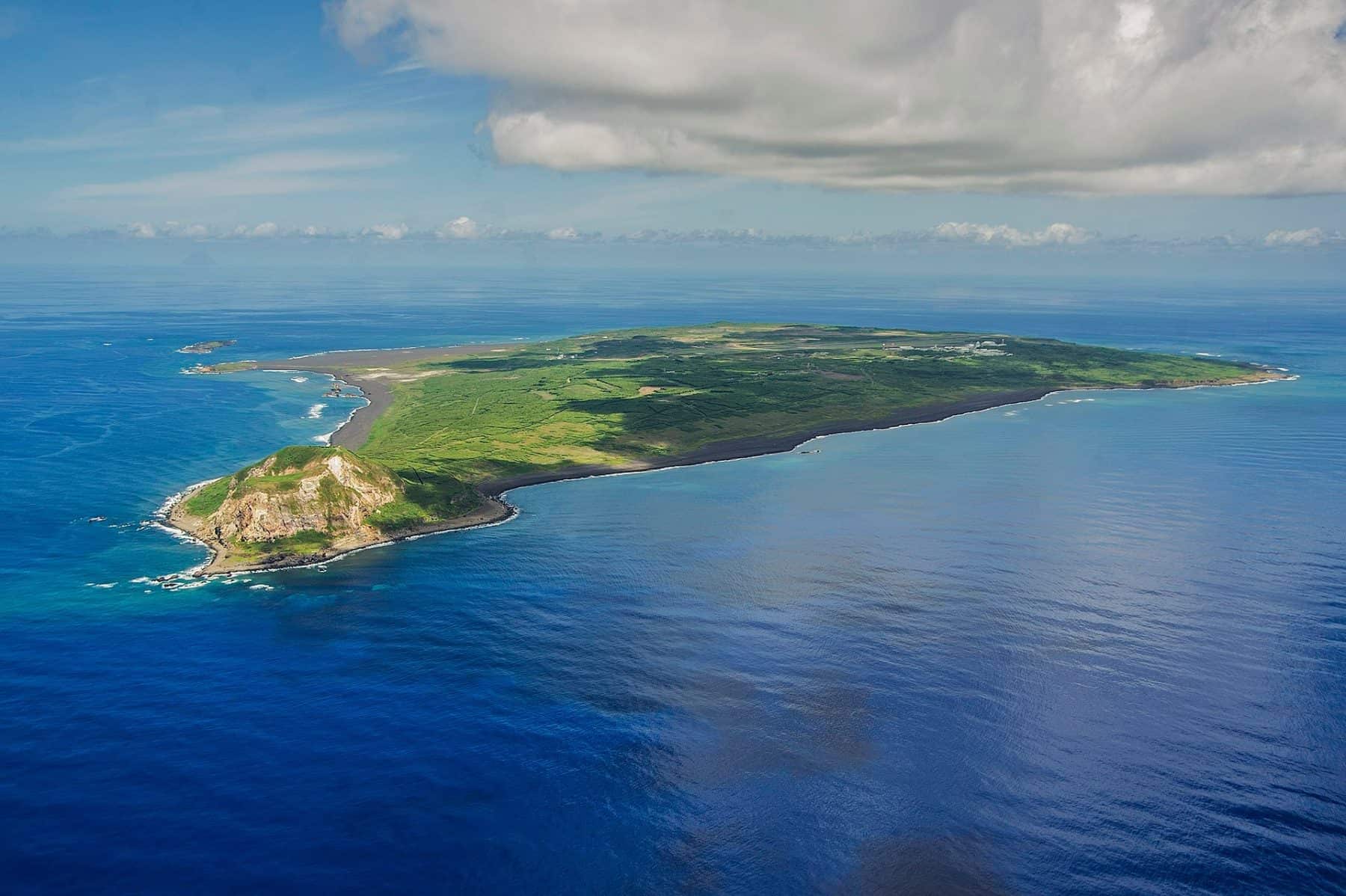
Though barely a spec on a map, it was significant for the war for two reasons: Number 1, American intelligence analysts believed that the Japanese airfields here could be captured and repurposed for American bombing missions in the heart of Japan, and Number 2, this was the very first piece of actual Japanese territory that the Americans attempted to conquer (though it was still some 500 miles away from Japan itself). So strategically and as a way to hurt Japanese morale, the island became a prime target.
The United States amassed over 500 ships and nearly 110,000 men to attack and conquer the island, which had almost 20,000 Japanese troops in defense. Before the battle even began, American bombing missions attempted to flatten Japanese resistance.
What the Americans did not know was that the Japanese had been preparing for this moment since the beginning of the war. They had built an elaborate underground network of rooms and connected tunnels, almost 11 miles of tunnels, including a “hospital” of sorts that could tend to 500 patients. American Marines led the charge in landing on the beaches to take on what they thought was a bombed-out defense.
Instead, they met a deadly game of “whack a mole” as Japanese troops emerged from secret tunnels to engage in firefights with American soldiers, only to retreat underground before the Americans could locate them. It quickly became some of the most intense fighting the Marine Corps had ever seen, even to this day. It was a brutal campaign, and this speck of nothing island took nearly 6 weeks to conquer. Every single Japanese soldier fought to the death, and the only POWs captured by the Americans were Japanese troops who had been knocked unconscious.
As the battle unfolded, American commanders began to realize the stakes of Iwo Jima. About a week into the battle, Americans finally captured the high ground of Mt. Surabachi, and a group of Marines planted an American flag that could be seen around the entire island. When the flag went up, a huge Marine Corps cheer, HOOHAAH! Erupted over the island.
Sec. of the Navy James Forrestal, the civilian in charge of the Navy, had just arrived on the island, saw the excitement of the flag raising, and knew that the flag would be an essential piece of history. He ordered it to be retrieved and given to him for safekeeping. The Marine commander on the ground believed that the flag belonged not to the Navy Secretary but to the Marine Corps and, specifically, the unit that had captured Mt. Surabachi. The Marine commander ordered a second group of Marines to take a larger, more prominent flag and raise that one. The Navy Secretary could get that one, while the Marine Corps would keep the original.
This is where the kernel of truth that spawns the myth of the flag-raising being staged starts. Indeed, the famous photograph does not show the first flag raising; it shows the second one. But it was not staged. The photographer, Joe Rosenthal, who would win a Pulitzer for this photo, was busy taking pictures of the first flag being lowered.
His buddy behind him, though, saw the Marines struggling to raise the second flag and tapped Rosenthal on his shoulder to try and get the shot. Rosenthal turned around, saw the picture, and started snapping. But the movement happened quickly, and Rosenthal didn’t have time to properly stage or focus or any of the things our cameras do automatically now. He just clicked the button. He assumed he missed the shot. It wasn’t until months later, after he sent his film back to the US to be developed, that his editor telegraphed him, saying he had THE shot of the war. Rosenthal assumed it was one of the other pictures he grabbed that day. So far from being “staged,” the photograph itself is an artistic miracle.
The published photograph soon became the defining image of the war. It immediately inspired Felix de Weldon, an Austrian who had moved to the United States and enlisted in the Navy during the war. He immediately sculpted a maquette, or a sort of first draft of a sculpture, during a single weekend. He and an architect friend soon proposed to Congress for a national Marine Corps memorial, but during the war, funding was impossible. In 1947, however, a federal foundation was created to fund the effort.
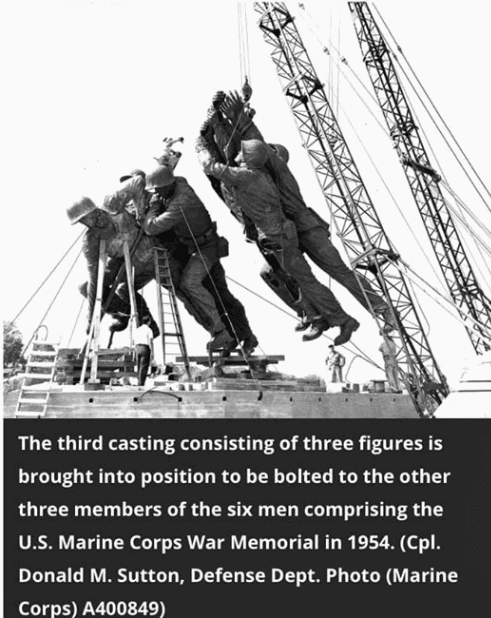
The memorial was officially approved in 1951. De Weldon spent 3 years creating a full-scale plaster model, with the pieces disassembled like a jig-saw puzzle and individually cast in bronze, and then reassembled how you see it now.
Move around the plaza. The pathways and the road leading to the memorial approach it from its east side. However, to see the "front" of the memorial, which mimics the famous photograph, you need to look at it from its west side, the side where you can see the Washington Monument across the river behind it.
The illusion does not work as well on foot as driving around the circle, but as you walk around the memorial, it looks like the flag is being raised.
Even standing here, you might not truly appreciate the scale of this masterpiece. The figures are roughly 32 feet tall, making the rifles on their backs about 19 feet. If you can find one of the knives hanging from their belts, that is roughly 5 ft. So, if you have some kids with you, you can point that out and say that knife is about their size!
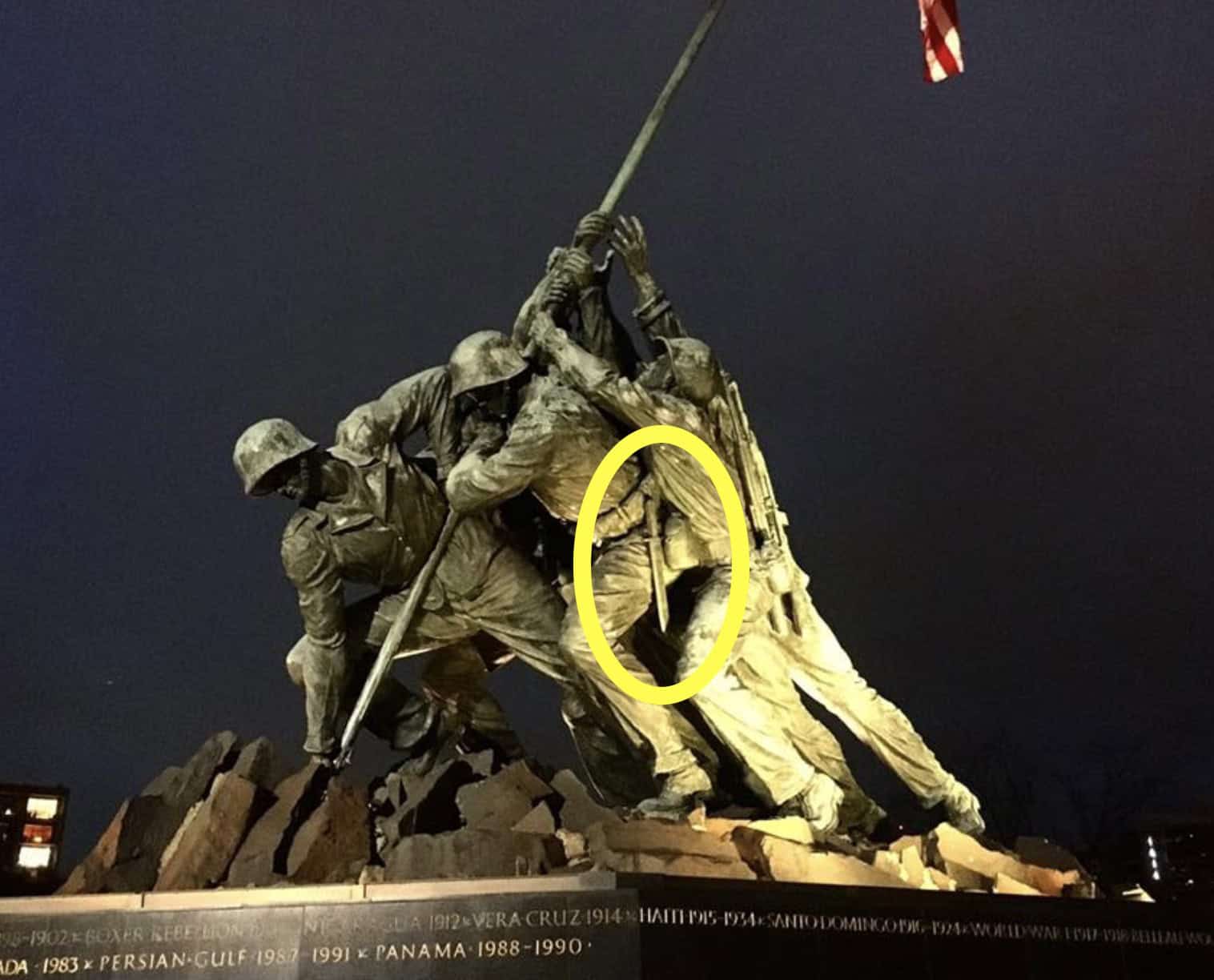
The memorial was dedicated by President Eisenhower on November 10th, 1954, the 179th Birthday of the Corps. In 1961, President Kennedy ordered that the American flag on the stature remain raised 24 hours a day, and even to this day, it is one of only a few flags that fly under such orders. It should be noted that in keeping with this Presidential Proclamation, the flag is modern and not historically accurate from 1945.
Around the base of the sculpture, you will find etched with gold leaf the names of all the major engagements that the Marines have been in throughout history. On its front side, the words “Uncommon Valor was a Common Virtue” and the Marine Corp motto, “Semper Fidelis,” Latin for “Always Faithful,” are written.

The 6 Statues
There has been much controversy around the men's identities in this photograph/sculpture, with the Marines concluding a definitive investigation into their identities in 2019. The author of the book Flags of Our Fathers, James Bradley, wrote about his father, John Bradley, who was identified early on as a flag raiser. However, the Navy investigation concluded that Bradley had been misidentified and was not actually in the photo, and neither was Rene Gagnon, also prominently featured in the book.
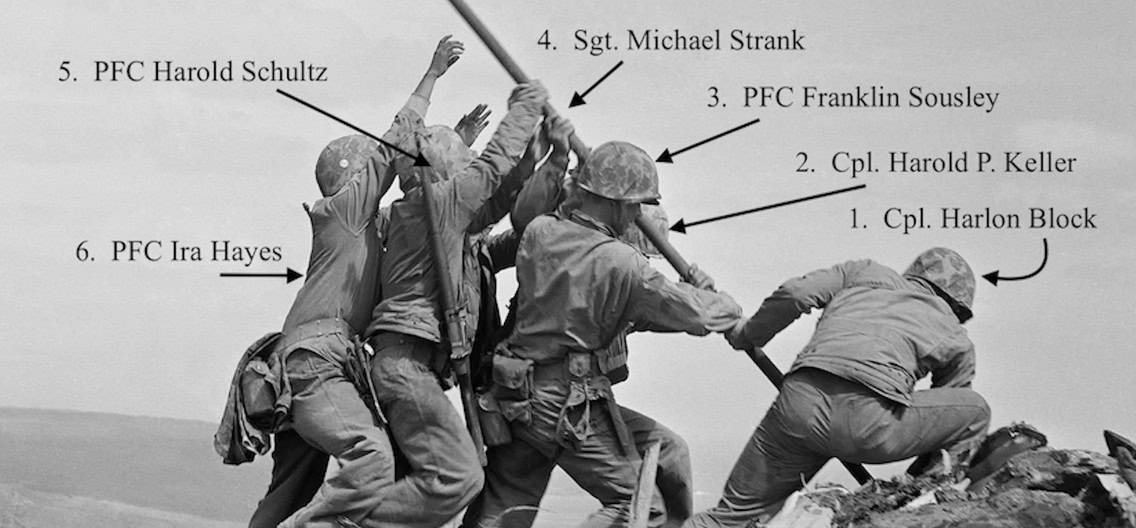
One man was identified correctly but tried everything to deny it, and that was Ira Hayes, a notoriously shy member of the Pima tribe of Native Americans, remembered in the famous Johnny Cash song, the Ballad of Ira Hayes. He attended the dedication ceremony of the memorial but was plagued by PTSD and self-medicated with alcohol. Just 2 months after the dedication, he was found dead from exposure, most likely wandering out into the cold after a night of drinking.
When we look at this magnificent sculpture, it’s common for people to feel a wave of triumph, but it is important to note that the battle of Iwo Jima wages on for 5 more weeks after this scene. Nearly 6,000 Marines sacrificed their lives to secure this critical island for the United States. 3 of the 6 flag raisers depicted here were among those that never left Iwo Jima.

The first thing that will catch your eye as you approach the memorial are the six 32-foot (10-meter) figures raising a 60-foot (18-meter) bronze flagpole.
From the outside in, the figures are Ira Hayes, Harold Schultz (initially identified as John Bradley), Michael Strank, Franklin Sousley, Harold Keller (identified initially as Rene Gagnon), and Harlon Block.
Felix de Weldon worked directly with the 3 survivors of the assault on Iwo Jima, Bradley, Gagnon, and Hayes, whose faces were modeled in clay.
Though Schultz and Keller both survived the war, neither was correctly identified as one of the original flag raisers until 2016 and 2019, so they were not part of the process of making the sculpture.
John Bradley was present for the first flag-raising (a separate event from this iconic image), which led to the confusion.
Casting the plaster models in bronze took nearly 3 years, and a team of highly skilled artisans would be involved in constructing the memorial.
The Flag
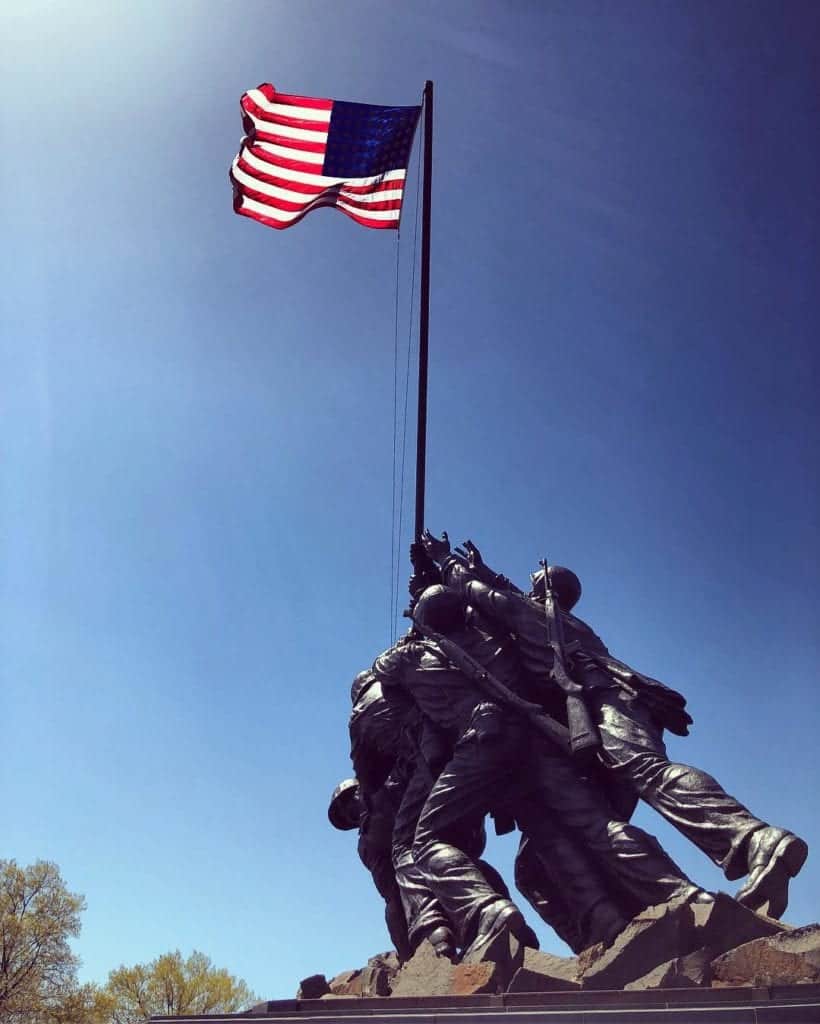
The flagpole the men are raising is 60 ft (18 m) tall and cast of bronze. The flag at the top flies 24 hours a day.
Although the flag had only 48 stars when the picture was taken, a modern flag flies with all 50 stars since this memorial honors all Marines, past and present.
The Base
The base of this memorial is 10 ft (3 m) tall and is made of polished black granite.
Engraved in gold around the memorial's base are the names of every principal Marine Corps engagement since its founding.
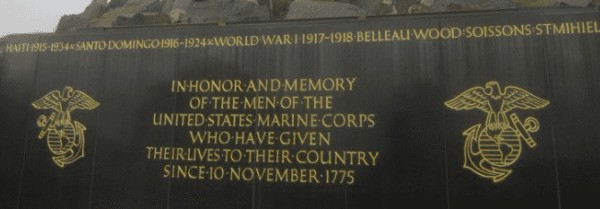
A few inscriptions are engraved on the base- on the front (west side) is "Uncommon Valor Was A Common Virtue."
"Semper Fidelis" (Latin for "always faithful") is the motto of the Marine Corps.
On the back (east side) is the inscription "In Honor And Memory Of The Men Of The United States Marine Corps Who Have Given Their Lives To Their Country Since 10 November 1775".
GUIDED TOURS AND RANGER TALKS
Ranger Talks:
While no set ranger talks are offered, visitors may request a ranger program at the US Marine Corps War Memorial by calling 703‑235-1530.
These talks are free and generally last for 1 hour.
Guided Sightseeing Tours
Due to its somewhat remote location, the memorial is not included in most tour company itineraries.
We include this memorial on our Arlington Cemetery walking tour as an optional stop. Private Bus/Car tours can request that we include this memorial on a route, as well.
Most night bus tours stop here. A few full-service bus companies make stops here on their daytime tours.
We recommend USA Guided Tours, but their competitors are also excellent. Read about them here.
Related Content